Planning gypsum works for your home or commercial space almost always raises one question first: Knauf or Rigips. The short answer is that both are German-engineered systems with comparable quality, and the right pick depends more on the room type (bathroom, living room, near a fireplace) than on the brand name itself.
This guide goes further than a quick FAQ answer. We compare the panel range, moisture and fire resistance, acoustic performance, pricing in the Albanian market and availability, so you can decide with complete information before starting your project.
Quick verdict: Knauf or Rigips?
If you are short on time, here is the summary:
- For standard work in living rooms, bedrooms and offices: both brands perform equally well, and the choice comes down to price and whatever stock is available at the time of purchase.
- For bathrooms, kitchens and any steam-heavy area: choose a moisture-resistant board (aquapanel) from either brand, never a standard board.
- For walls near a fireplace, open-flame kitchens or fire-rated partitions: choose a speciality fire-resistant board with an appropriate thickness and layering.
- For large areas on a tight budget: compare the current price of both brands at your local supplier, since the gap occasionally favours one over the other.
Comparison table: Knauf vs Rigips
| Criterion | Knauf | Rigips | |---|---|---| | Panel range | Standard, moisture-resistant, fire-resistant, acoustic, impact-resistant | Standard, moisture-resistant, fire-resistant, acoustic, impact-resistant | | Moisture resistance | Green board with hydrophobic paperboard, suited to bathrooms/kitchens | Green board with treated core, comparable performance | | Fire resistance | Up to 120 minutes depending on thickness and number of layers | Up to 120 minutes depending on thickness and number of layers | | Acoustic rating | Up to roughly 45 dB with a double-frame build up and mineral insulation | Up to roughly 45 dB with a double-frame build up and mineral insulation | | Typical price (full partition) | 3500 to 4500 Lek/m² with frame and insulation | 3500 to 4500 Lek/m² with frame and insulation | | Availability in Albania | Widely stocked in Tirana and Durrës, steady supply | Widely available, occasionally slightly better priced depending on supplier |
As the table shows, the technical differences between the two brands are small. That is exactly why an experienced installer matters more than the name printed on the box.
Panel range: what each brand offers
Both manufacturers offer full lines of gypsum boards that cover practically every construction scenario. The standard board is 12.5 millimetres thick and is used for suspended ceilings, partitions and wall cladding in dry areas such as living rooms, bedrooms and hallways.
Beyond the standard board, the range includes:
- Moisture-resistant boards (known as aquapanel), with a green paperboard or hydrophobic-treated core, used for bathrooms, kitchens and basements.
- Fire-resistant boards, with added glass fibres in the core that give higher resistance to extreme temperatures, used near fireplaces, industrial kitchens and fire-rated partitions as required by the project.
- Acoustic boards, with higher density for superior sound insulation in apartments with thin partition walls.
- Flexible boards, thinner (6 to 8 mm), used for curved walls and ceilings in modern designs.
For full technical specifications of each line, the official Knauf catalogue lists detailed data for every board type. As we explained in why gypsum is a key material in modern construction, the biggest advantage of gypsum as a system is its flexibility: the same base material adapts to ceilings, partitions and wall cladding simply by changing the board type and supporting frame.
Regardless of the brand chosen, the step that follows board installation is the same: filling the joints between boards with joint compound. This layer covers the screws and board edges, creating a single smooth surface before plastering begins.
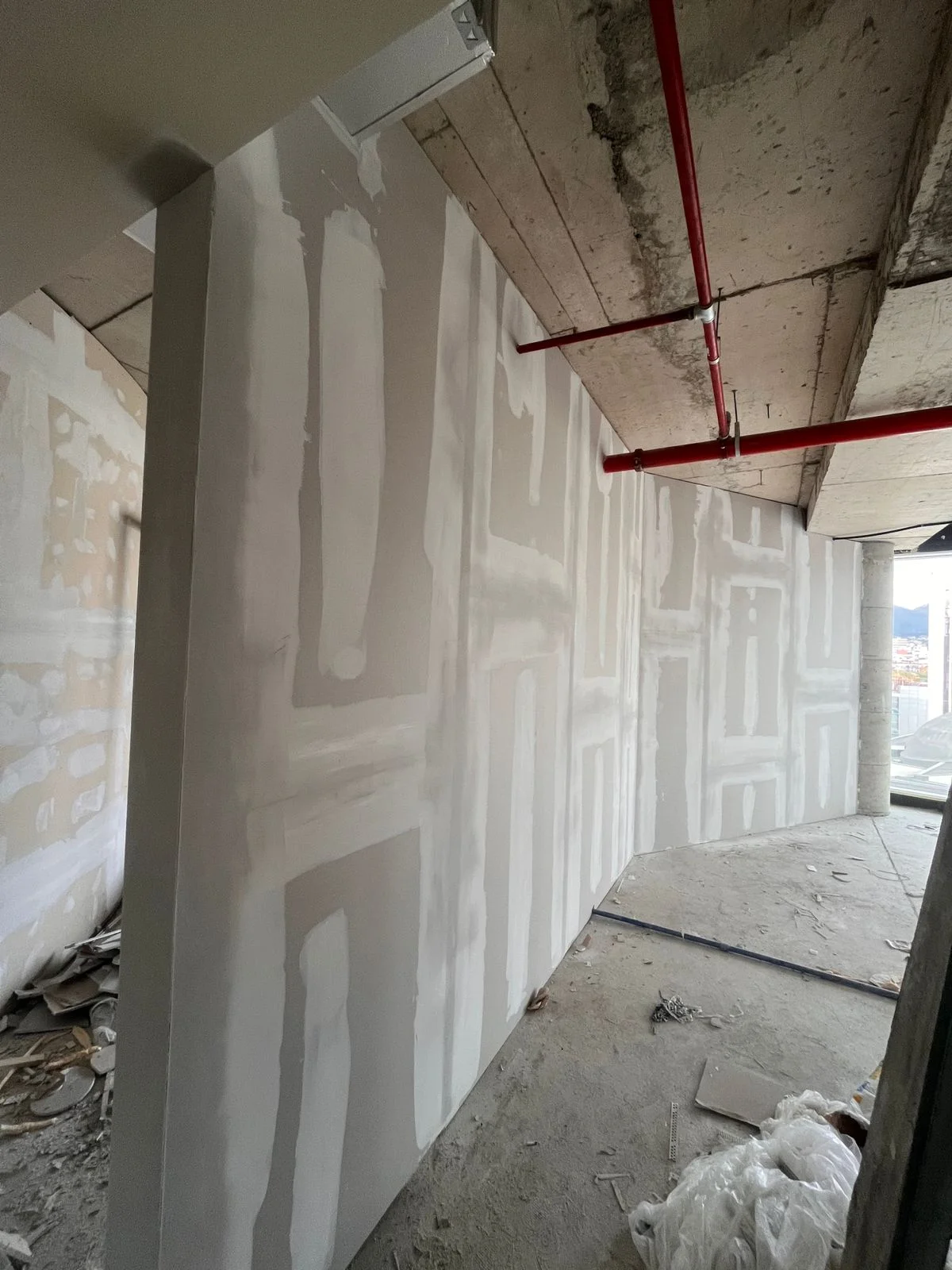 Jointing between Knauf and Rigips boards, a standard step before plastering and painting
This stage needs roughly 24 hours of drying time per coat of joint compound, whether the boards are Knauf or Rigips, and it is exactly the bridge that connects gypsum work with the following phases of plastering and painting.
Which is more moisture resistant, Knauf or Rigips?
Both brands offer green moisture-resistant board with practically equivalent performance for residential projects. The real difference is not the brand but correct installation: galvanised screws and profiles, proper clearance from wet surfaces, and additional waterproofing behind tiles in bathrooms, which are what actually determine how long the system lasts.
For bathrooms and kitchens, standard board is not recommended at all, regardless of brand, because ordinary paperboard absorbs steam and encourages mould growth over time. Aquapanel-type board should be the default choice for any wall or ceiling near a shower, bathtub or hob.
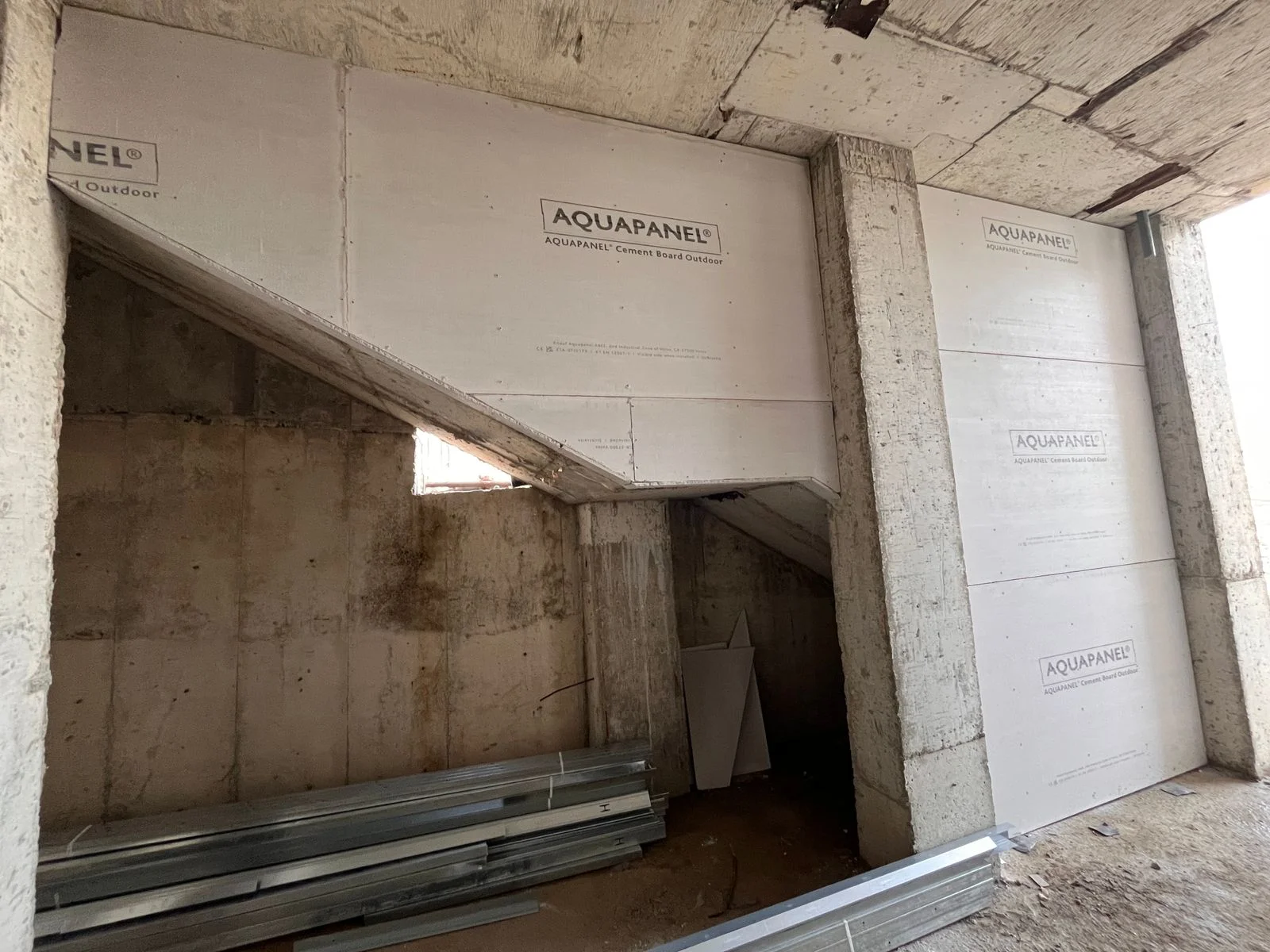 Moisture-resistant aquapanel board installation, completed by the Torra Gips team
How fire resistant are Knauf and Rigips boards?
Standard gypsum boards offer some inherent fire resistance because of the water chemically bound in the gypsum core, which is released slowly as steam when exposed to heat. Speciality fire-resistant boards, made by both brands with added glass fibres in the core, typically reach fire resistance up to 120 minutes, depending on thickness, number of layers and the supporting structure used.
This figure is a general industry benchmark, not a fixed guarantee for every installation, since real certification depends on the full tested system (board plus frame plus insulation), not the board alone. The chemical composition of gypsum board and its role in fire resistance is explained in more depth on the Wikipedia drywall entry. For homes with a fireplace or wood stove, we always recommend fire-resistant board in the immediate heat radius, even when the rest of the room uses standard board.
Acoustic performance: how much noise do gypsum boards block
A single gypsum board on a metal frame reduces noise by a moderate amount, but combining two boards with an air gap and mineral insulation inside the frame changes the result substantially. Double-board systems with insulation can reach acoustic reduction of up to roughly 45 decibels, a typical industry figure that makes the partition noticeably quieter compared with a simple single-board wall.
For apartments in newer buildings with thin partition walls, this is why we recommend a double-frame build up with mineral insulation whenever budget allows, especially between bedrooms and shared living areas.
Pricing: how much do Knauf and Rigips systems cost in Albania
Price is often the deciding factor between the two brands, but market gaps are small and shift depending on the supplier and the timing of your purchase. In general:
| Work item | Guide price (Lek/m²) | |---|---| | Wall cladding with standard board | 1500 to 3500 | | Full partition with frame and insulation | 3500 to 4500 | | Moisture-resistant board (added over base price) | +10% to +20% | | Fire-resistant board (added over base price) | +15% to +25% |
The difference between Knauf and Rigips board pricing itself is usually minimal, a few hundred Lek per pack, and often depends more on the supplier and current promotions than on the brand. For pricing tailored to your project, see our pricing page or request a free quote.
Availability in the Albanian market
Both brands are widely stocked by building material suppliers in Tirana and Durrës, with steady supply for standard boards. Speciality boards (moisture-resistant or fire-resistant) sometimes require advance ordering from the supplier, particularly for large quantities on commercial projects.
At Torra Gips, we work with both brands regularly and stay in direct contact with the main suppliers in Tirana, which lets us confirm availability of the right board at the quoting stage, avoiding surprise delays during installation.
Choose Knauf if... Choose Rigips if...
Since technical performance between the two brands is so similar, the practical decision often comes down to a few concrete factors:
Choose Knauf if:
- Your local supplier has fuller stock of the Knauf line at the time of your project
- Your installation team has more specific experience with Knauf profiles and accessories
- You need a specific product from their line that is not easily found in alternatives
Choose Rigips if:
- Rigips pricing is currently more favourable at your supplier
- The project needs boards with fast availability and Rigips is the in-stock option
- You previously used Rigips systems in the same building and want material consistency
In practice, our team assesses stock, price and technical requirements for each project before recommending a final brand, rather than defaulting to a single choice for every client. We also factor in what has already been used elsewhere in the same building, since matching an existing system can simplify future repairs and reduce the number of different profile types a maintenance crew needs to keep on hand.
Read more
- Why gypsum is a key material in modern construction to understand the general advantages of gypsum as a building system
- Types of modern gypsum ceilings for a complete guide to every ceiling style
- Interior construction phases: gypsum, plastering, painting to see where board selection fits within the full process
Why choose Torra Gips for Knauf and Rigips installation?
With experience across more than 100 projects in Tirana and Durrës, including prestigious work such as Vlora International Airport and Green Coast Resort, our team has worked extensively with both brands, from private apartments to commercial spaces with strict technical requirements. That experience lets us recommend the right brand and board type for each specific situation, not just a default choice.
If you are unsure which system your project needs, message us on WhatsApp at +355 68 858 0058 or contact us today for a free consultation. We will assess your space (moisture exposure, fire requirements, acoustic needs) and recommend the best fit between Knauf and Rigips, with transparent pricing and no surprises.